
Tuesday, June 7, 1988
Telegraph Newspaper Clipping
By HATTIE BERNSTEIN Telegraph Staff
NEW IPSWICH Talk about bargains. For three dollars, the town’s Conservation Commission has taken a 50-year lease with the state for three dam sites it plans to develop for recreation areas and the protection of wildlife.
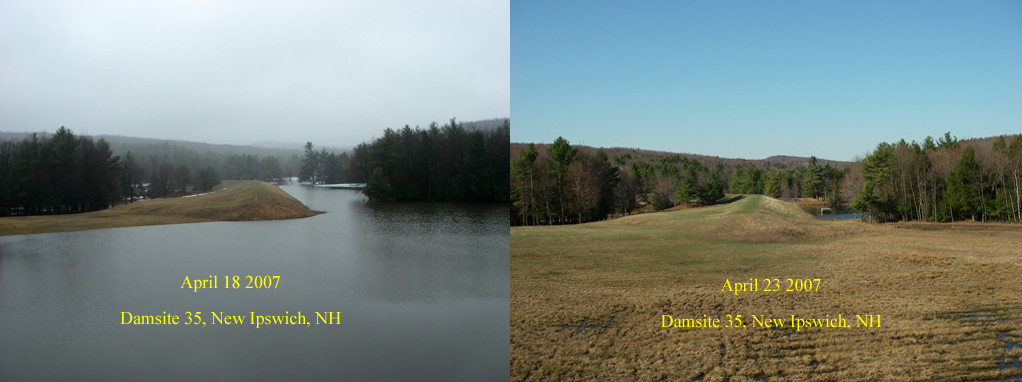
The sites a two-acre parcel off Temple Road, a 17-acre area off Thayer Road and 35 acres near Binney Hill Road are among five dam sites statewide owned by the state and leased at minimal cost to provide open spaces and public recreation.
The dams, which are earthen barriers designed to hold back water during heavy rains, are maintained by the state.
The dams in-New Ipswich, leased for $1 each on the 50-year plan, were built in the 1960s to protect the area from flooding. Under state jurisdiction, the dams continue to serve their original purpose, said William Chandler, land agent for the state Water Resources Division of the Department of Environmental Services.
It was Chandler who tipped off thetown’s Conservation Commission to the rental deal. The state had leased a 200-acre dam site to the town of Lyndeborough about eight years earlier and Chandler said he thought New Ipswich might benefit from a similar rental.
More recently, the state signed a like agreement with the town of Goshen, in western New Hampshire for a dam site of more than 100 acres, which will be used for recreation and conservation purposes, Chandler said.
The leasing agreement between New Ipswich and the state was signed on March 10.
“I was interested immediately,” recalled Conservation Commission member Mary Jane Grasty, who was serving as chairman when Chandler made his suggestion about a year ago. Voters at Town Meeting last year approved the leasing agreement. In March, at the 1988 Town Meeting, voters said “yes” to a management plan for the sites.
While the leasing arrangement leaves the state in charge of the dam itself, it transfers responsibility for the adjacent land to the locals. And that, Grasty maintains, sets up a “fair trade.” In exchange for the low rent, the town agrees to maintain and police the recreation sites.
Before the town assumed responsibility for the sites, the areas were used informally for fishing, hunting and partying, said Oiva Anderson, a Conservation Commission member.
With the lease agreement, he said. the use of the land becomes restricted to “passive recreation” like hiking, camping, picnicking and bird-watching. Hunting is strictly regulated. Motor vehicles are prohibited. The same goes for trashing the picnic sites.
Like other members of the town’s Conservation Commission, Anderson said he’s encouraged by the rental because it means the town will pre- serve valuable open spaces and woods. “The town is very short of any kind of public recreational space. I think this can be a very valuable asset.” Anderson said.
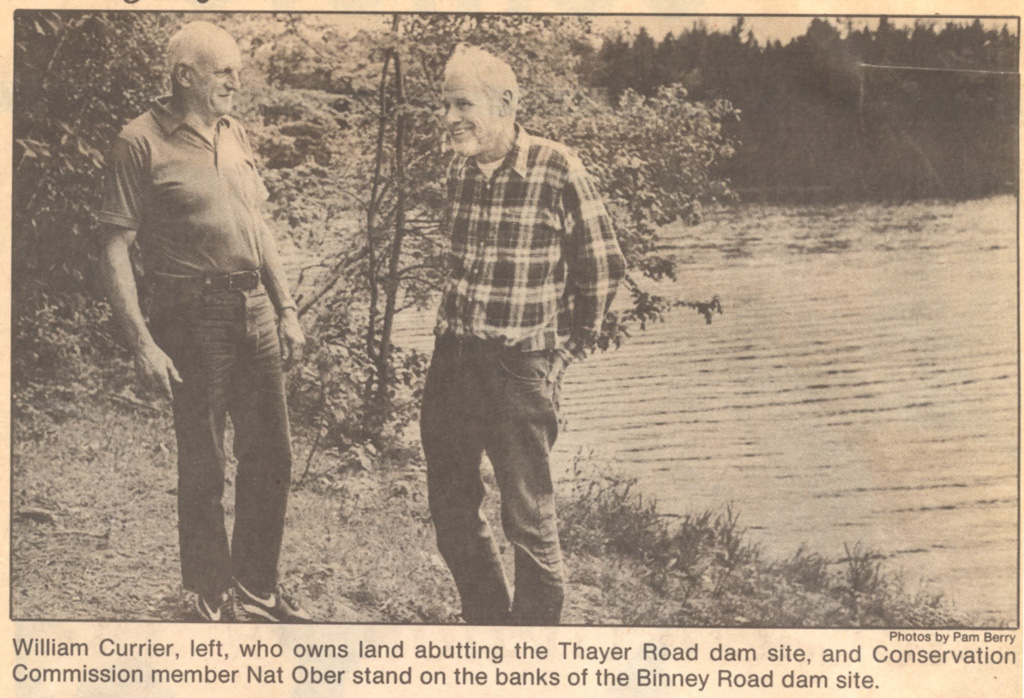
Others agree that the preservation of the dam sites is one way the town can stem at least in part the gobbling by developers of the area’s open spaces. “This town is probably the most rapidly growing town in New Hampshire right now,” said Nat Ober, another Conservation Commission member.”… It’s very important that we preserve some land for public use.”
Plans for the three sites are simple. Grasty estimates that the Conservation Commission will spend under $1,000 to install fences, gates, picnic tables and trash barrels on two of the three sites. The two-acre area off Temple Road, she said, because of its smallness, will be left in its natural state. At the two larger sites, the town will clear small sections for parking and trails, but will mostly leave the woods and fields as they are now.
Long-range plans for the 50-year lease, said Anderson, don’t go beyond figuring out how to best preserve and maintain the land and water, which are rich in vegetation and wildlife. At the site off Binney Hill Road, for example, wetland contains aquatic plants such as pond lily, algae, cattails, red maple, and heath shrubs. The site also provides habitat for ducks, geese, swallows, hawks, beaver, racoons, snakes, turtles, and frogs.
Officials say local control of the sites will protect the areas from vandalism and abuse by dirt bikers and beer drinkers. Because the lands fell under state jurisdiction, some say, local police often overlooked problems in these areas. But with the creation of public access – and public pride officials say, they expect better-tended sanctuaries.
“We’ll improve them only slightly,” said Anderson, “to enhance public availability for recreation.” Anderson describes the current plan as “almost benign neglect.”
Because of their muddy, stumpy bottoms, none of the ponds located on the dam sites is suitable for swimming. But conservationists say they’ll encourage canoeing, rowboating, and in winter, skating and ice fishing.
Liability falls on the shoulders of the town – under its insurance cover- age. Development of the sites and consequent maintenance are the financial domain of the Conservation Commission.


Leave a Reply