
Saturday, June 20th, 2:00PM at the New Ipswich Library, 6 Main Street.
A New Hampshire Humanities event hosted by New Ipswich Historical Society.
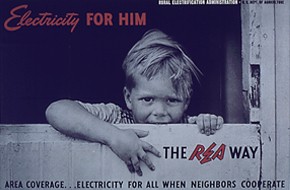
Imagine a town where some people enjoyed the benefits of electricity – lighting at the flick of a switch and reliable heating regulated by a thermostat – while others lived with smelly kerosene lamps and smoky box stoves. In New Hampshire, during the first half of the 20th century, residents of developed communities enjoyed the transformative benefits of electric power while those in sparsely populated areas lived and worked in conditions little changed from the 19th century. It took the coming of the New Deal’s Rural Electrification Administration and a determined band of farmers to overcome opposition from the established private utilities to create the New Hampshire Electric Cooperative in 1939. Despite labor and material shortages during WWII, within a decade, power came to almost all of the previously unserved regions of the state. For thousands of households, this meant relief from the drudgery of the wood-fueled cookstove, the washboard and the kerosene lamp. Reliable electric power similarly brought new ways of life to farmers and artisans. This program will explore how these developments changed civic and social life in New Hampshire’s countryside, and touch on ways the disparity of broadband access in the state echo these earlier struggles.
A lifelong scholar of NH agriculture and rural life, Steve Taylor has been a daily newspaper reporter and editor, freelance writer, dairy farmer and for 25 years served as the state’s Commissioner of Agriculture. He was the founding executive director of the Hampshire Humanities Council and in recent years has actively participated in its Humanities to Go program.
This presentation is free and open to the public. It is funded by New Hampshire Humanities and Stearns-Burton Lecture Fund. Parking is available along Main Street in front and on the lawn of the Historical Society (23 Main) and in lot adjacent to the library.
Leave a Reply